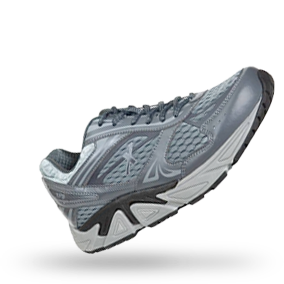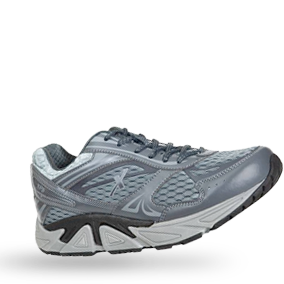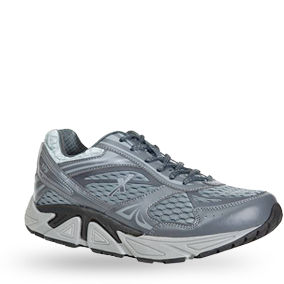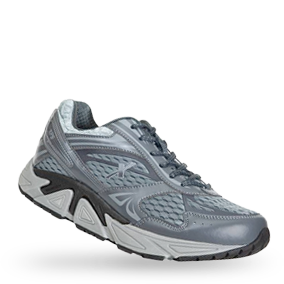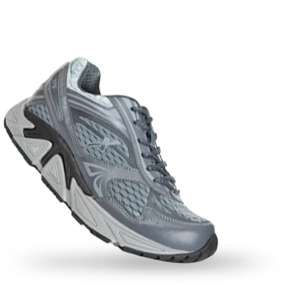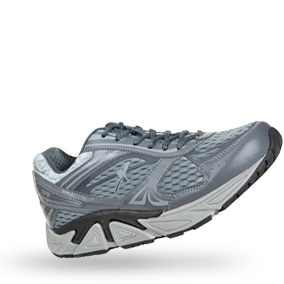
You probably have a pair you go to by the door and another you save for certain days. One is leather. Tough and shiny. And the other is mesh. Light and breathable.
Ever wondered why you instinctively reach for one over the other? It really comes down to material performance and how it feels on your feet.
So, leather vs. mesh shoes: which is better for everyday walking? It depends on your gait, where you wear them, and what your feet need.
The upper is the part of the shoe that wraps around your foot. Leather and mesh behave very differently because they are designed with different priorities in mind.
Leather shoes have a more structured feel. Good leather keeps its shape, resists everyday wear and tear, and looks equally good with casual or dressier clothing. If it is properly cared for, leather can also last a long time.
Mesh shoes are typically lighter and more breathable. Since they’re woven, they allow more air around your feet, which can be especially helpful if you’re on your feet a lot or have a tendency to get hot in your shoes.
That difference becomes more noticeable during daily wear.
| Feature | Leather Shoes | Mesh Shoes |
| Breathability | Low to moderate, depending on construction | Generally high |
| Weight | Usually heavier | Usually lighter |
| Durability | Generally excellent | Depends heavily on mesh quality and construction |
| Structure | Naturally structured | Requires reinforcement for support |
| Flexibility | Can become more flexible with wear | Usually flexible from the start |
| Moisture management | Can retain more heat and moisture | Generally allows more airflow |
| Water resistance | Often better | Usually limited unless specially treated |
| Style | Polished and versatile | Sporty and casual |
| Everyday walking | Excellent for structured support and durability | Excellent for lightweight comfort and breathability |
The key thing to remember is that material alone doesn’t make a walking shoe supportive. A leather shoe can still lack the stability your feet need, while a mesh shoe, if well designed, can have great structure.
A good quality leather upper can give a secure, supportive feeling around the foot and be durable enough for regular use. Leather also naturally works in settings where you want your walking shoes to look a bit more refined.
This makes leather particularly useful for:
But there’s a tradeoff. Leather generally doesn’t allow for the same amount of airflow as an open or engineered mesh upper. If your feet get hot or sweaty on long walks, you may find a breathable shoe more comfortable.
Xelero Shoes offers leather options that blend the structure of the material with technologies to help support the motion of your foot. The Zurich, for example, has an oiled full-grain leather upper and a breathable moisture-wicking liner, but it incorporates Xelero motion-control technology.
If you’re walking around town, traveling, working out, or just spending most of your day on your feet, less excess weight and more airflow can make a big difference.
Mesh can be especially appealing for:
However, don’t assume that a fabric upper means the shoe lacks support.
Xelero Shoes features molded heel counters and reinforced toe boxes to strengthen the fabric uppers. The Genesis features a mesh/leather combo for breathability but still has structure, while the Steadfast II features a seamless fly-knit upper with a molded heel counter and a reinforced toe box.
The X-GPS pushes the lightweight concept even further with an all-fabric upper designed for breathability, along with molded heel and toe support and Xelero’s rocker technology.
Every step involves your heel, arch, forefoot, ankle, knees, hips, and the rest of your body working together.
That’s why you should also look at:
A walking shoe should provide a stable platform underfoot. Xelero Shoes uses a Carbon Nylon Control Plate to enhance stability and decrease pressure underfoot.
A shoe shouldn’t make every step feel like work. Xelero’s Propulsion Element is designed to promote stability and control, but also to encourage forward motion.
The midsole rocker helps move the foot through the gait cycle, easing the transition from heel to toe.
Xelero Shoes has gel pads in the midsole below the heel and forefoot to absorb shock, yet keep you stable and in control of your movements.
Even the most advanced walking shoe won’t feel right if it doesn’t fit your foot.
Xelero Shoes are designed with extra depth for custom orthotics. Many styles also feature an adjustable fit system, which allows you to adjust the space inside the shoe as your feet change throughout the day.
That’s particularly useful because your feet don’t necessarily stay the same size from morning to evening.
Climate and habit are as much to be considered as personal taste. In hot, humid climates, people naturally gravitate toward mesh, for obvious reasons: better airflow, quicker drying, less discomfort from trapped moisture. Cooler climates or rougher job conditions tend to favor leather’s durability and resistance to weather.
If you are walking for hours at a stretch, breathability will likely become more important than structure for most people. If you spend most of your time on your feet or walking short distances, and get caught in the rain or dust once in a while, the durability of leather is the bigger benefit.
U.S. footwear sales gained 1% in the first half of 2026, Circana reported, with performance footwear increasing 6%. Running shoes, up 13% in both dollars and units, were one of the strongest categories.
Leather is still very important too. Mordor Intelligence estimates the global leather footwear market will reach $130.75 billion by 2026 and $169.03 billion by 2031. The report cites durability, premium positioning, and the continuing popularity of casual leather footwear as demand drivers.
If you want something breathable and lightweight for comfort, mesh is generally the better choice.
If durability, structure, water resistance, and a more polished look are more important, then leather might be a better fit.
You want a shoe that supports your foot, cushions properly, gives you a stable base, fits well, and works naturally with the way you stride.
The bigger lesson when comparing leather vs. mesh shoes for walking is that the upper is only one part of the equation.
Xelero Shoes pairs supportive uppers with motion-control technology, cushioning, stability, and a rocker system that helps you move forward more easily.
Whether you pick leather, mesh, or a combination of the two, your goal should be the same: comfortable shoes that support your natural movement throughout the day.
Explore Xelero Shoes to find footwear designed around stability, support, and the way you move.
Q: Is leather or mesh better for everyday walking?
A: Depending on your routine and climate. Mesh is generally better for long periods on your feet and in warmer conditions. Leather is more durable and structured for daily wear with rougher terrain or exposure to the elements.
Q: Do mesh shoes wear out faster than leather shoes?
A: Yes, generally. Leather is more resilient to everyday abrasion, and mesh uppers tend to wear faster than leather at high-friction points like the toe box.
Q: Are leather shoes too hot for daily walking?
A: Leather holds more heat and moisture than mesh, so it can feel warmer over a full day, but conditioning it properly and rotating it with breathable shoes can help.
Q: Can a shoe combine both leather and mesh?
A: Yes, a lot of walking shoes have leather or synthetic overlays with mesh panels to offer a balance of durability and breathability where it is most needed.